
Worship Explained
A Guide to the Episcopal Service
What to Expect in Worship
If you’re new, or even if you’ve been coming for years, you might sometimes wonder what’s happening during the service, or why things are done the way they are. Episcopal worship follows a rhythm that is both simple and meaningful, moving from gathering, to listening, to responding, to sharing a meal, and finally being sent back out into the world.
You don’t need to understand everything to take part. There’s no expectation to get each response right or to know when to stand or sit. You’re welcome to follow along as much or as little as you’d like. Simply being present is already participation.
The sections below walk through the service step by step, from the quiet moments before we begin to the sending at the end, offering a gentle guide to what you might see, hear, and do. Whether you’re exploring for the first time or looking to see something familiar in a new way, our hope is that this will help you feel more comfortable, more connected, and more at home in worship.
Before We Begin: Arriving and Preparing
Before the service officially begins, there is a quiet time of gathering and preparation. As people arrive, you might notice soft conversation, a moment of stillness, or music being played, often called the prelude, which helps create a space for reflection. This time isn’t just “waiting” for something to start; it’s part of worship itself, a gentle transition from the busyness of daily life into something more intentional. Some people use this time to pray, to notice the beauty of the space, or simply to settle in. Whether you arrive early or just in time, you are already part of the gathered community.
- Arriving at the church
As you enter, you may be greeted by an usher or welcomed by others. This is simply a time to find your way and get settled.
-- If you’re unsure where to go, it’s perfectly okay to ask someone nearby.
- Entering the worship space
When you step into the sanctuary, you might notice a quieter atmosphere than outside. Some people sit in silence; others may speak softly.
-- There’s no one “right” way to enter; just be yourself and settle in.
- Finding a seat
You’re free to sit wherever you feel comfortable. Some people prefer the back, others the middle or front.
-- If the service includes books or a printed bulletin, you can pick one up or will be handed one.
- The prelude (music before the service)
Music often begins before the service starts. This is called the prelude.
-- You don’t need to do anything during this time; just listen, reflect, or let your mind slow down.
- Personal preparation
Many people use this time for quiet prayer, reflection, or simply taking a breath after the week.
-- You might notice others bowing their heads or sitting quietly; feel free to do the same, or just sit comfortably.
- Becoming aware of the space
You may notice candles, the altar, the windows, or other visual elements.
-- These are all part of the environment of worship, meant to draw attention to God’s presence.
- The sense of gathering
Even before anything formally begins, the community is already forming; people arriving, settling, and becoming present together.
-- Simply being there is already participation.
You don’t have to prepare perfectly, this is simply a moment to arrive, as you are.
Gathering: Becoming a Community
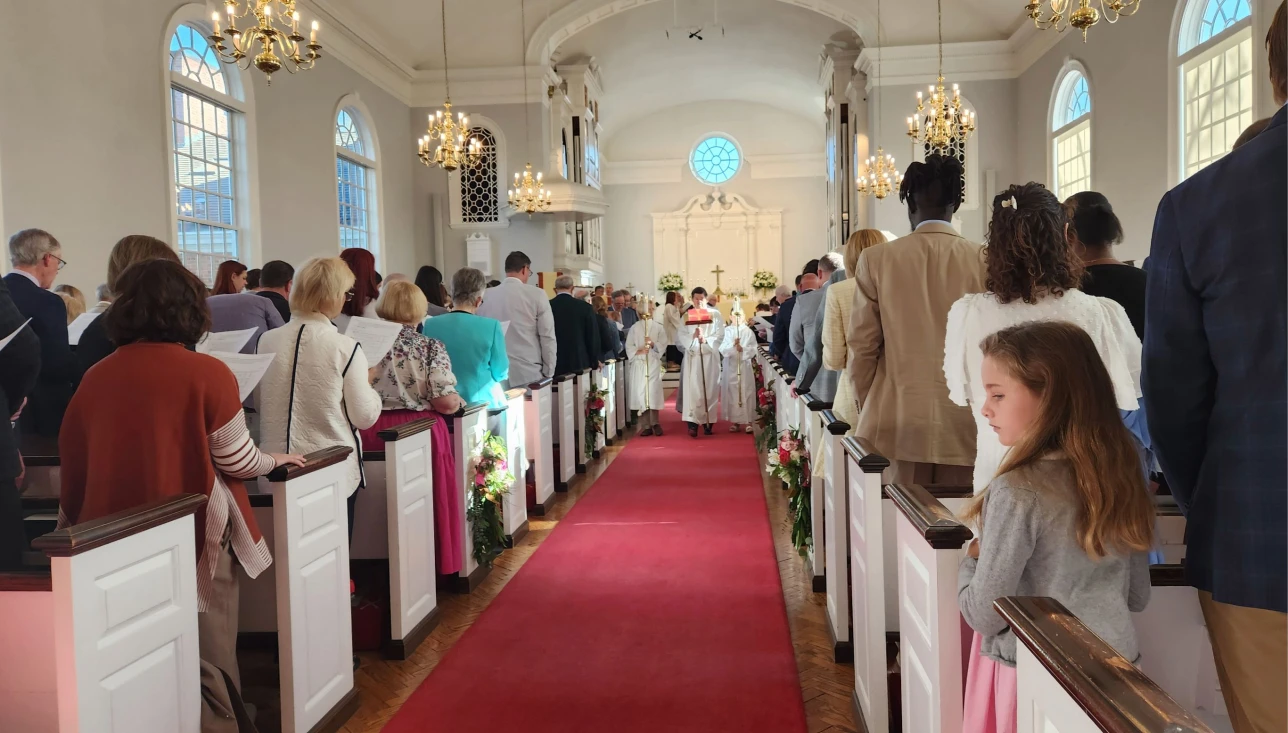
As the service begins, we shift from being individuals finding our seats to becoming a gathered community. This often starts with a hymn and a procession, as leaders and ministers move through the space and take their places. The opening words of the service name God as the center of what we’re doing, and the prayers that follow help us settle into a shared purpose. One detail you might not notice at first is that many of these prayers are “collects”, short prayers designed to gather our thoughts into a single focus. Together, this opening movement reminds us that worship is something we do not do alone, but together, as one body.
- The service begins (often with music)
A hymn or piece of music signals that the service is starting.
-- You’re invited to stand if you’re able and join in singing, or simply listen.
- The procession
The clergy, choir, and other ministers enter, usually moving down the aisle toward the front.
-- You can watch this unfold. It’s part of how the community gathers itself for worship.
- The Opening Acclamation
The priest begins with a short exchange like, “Blessed be God…” and the congregation responds.
-- These words are printed in your bulletin; you’re welcome to join in.
- The Collect for Purity (or opening prayer)
A prayer asking God to prepare our hearts and minds for worship.
-- You may stand quietly, listen, or follow along if you’d like.
- Song of Praise (Gloria, Kyrie, or similar)
A spoken or sung prayer of praise (or, in some seasons, a prayer asking for mercy).
-- This is often sung together, but you can participate at whatever level feels comfortable.
- The Collect of the Day
A short, focused prayer that reflects the theme of the day’s readings.
-- You’ll often hear an invitation like “Let us pray,” followed by a brief silence.
- A shared moment of “Amen”
The congregation responds “Amen” together at the end of the prayer.
-- This simply means “so be it”, a shared way of saying we agree in prayer.
By the end of this opening, what began as a room of individuals has become a community gathered for worship.
The Word: Listening for God
In this part of the service, we focus on listening to scripture, to tradition, and to how God might be speaking in our own lives. You’ll hear several readings, usually from different parts of the Bible, followed by a sermon that reflects on them. If you’re new, it might feel like a lot of readings at first, but there’s a rhythm to it: we hear from the Old Testament, the Psalms, and the New Testament, before turning to the Gospel, which is given special attention. One detail many people don’t realize is that this pattern follows a shared calendar used across many churches, so that people around the world are often hearing the same readings on the same day. Together, this part of the service reminds us that faith is not just something we feel, but something we listen for and grow into over time.
- The first reading
A passage is read, usually from the Old Testament (or Acts during certain seasons).
-- You’ll likely be seated and invited to listen.
- Response: “The Word of the Lord”
After each reading, the reader may say, “The Word of the Lord,” and the congregation responds.
-- You’re welcome to join in saying, “Thanks be to God.”
- The psalm
A psalm (a poetic prayer from the Bible) is shared, sometimes spoken together, sometimes sung.
-- This is one of the places where the congregation participates more actively, but simply listening is always okay.
- The second reading
A passage from the New Testament letters (Epistles).
-- Like the first reading, this is a time for listening and reflection.
- Preparing for the Gospel
People usually stand, and there may be music or a short acclamation.
-- If you’re able, you can stand with the congregation. This signals that something central is about to happen.
- The Gospel reading
A passage from one of the four Gospels (Matthew, Mark, Luke, or John).
-- This reading is set apart because it tells directly about the life and teachings of Jesus.
- The sermon
A reflection offered by clergy (or occasionally another speaker), connecting the readings to daily life.
-- There’s no pressure to “follow” every point. Just take in what resonates.
- A moment to reflect
After the sermon, there may be a brief pause or quiet transition.
-- This is a natural moment to consider what you’ve heard, or simply sit in stillness.
In this part of the service, we practice listening, trusting that God can meet us through words that have been passed down for generations.
Responding: What We Do With What We’ve Heard
After listening to scripture and the sermon, the service shifts from receiving to responding. Together, we affirm our shared faith, pray for the needs of the world, and acknowledge where we fall short, and where grace meets us. If you’re new, this might feel like a lot of speaking and standing, but there’s a simple flow: we say what we believe, we pray for others, and we make space for honesty before God. One detail that often goes unnoticed is that these prayers are intentionally communal; they’re written in the language of “we,” not “I,” reminding us that faith is something we live out together. By the time we share the Peace, greeting one another in reconciliation and goodwill, we’ve moved from listening as individuals to responding as a community.
- The Nicene Creed
The congregation stands and says a statement of shared belief together.
-- You can join in if you’d like, or simply listen. There’s no expectation to know it.
- Prayers of the People
A series of prayers are offered for the church, the world, and those in need.
-- You may hear responses like “Lord, hear our prayer,” which you’re welcome to say along with others.
- Naming the needs of the world
These prayers often include space for current events, people who are sick, or those who have died.
-- This is a moment where the life of the world connects with worship.
- Confession of Sin
The congregation joins in a prayer acknowledging brokenness and asking for forgiveness.
-- You can participate fully, or simply listen. Either is completely okay.
- Absolution (words of forgiveness)
The priest speaks words of assurance that God’s grace and forgiveness are present.
-- This is meant to be heard as good news, not judgment.
- The Peace
The priest invites the congregation to “share the peace,” and people greet one another,often with a handshake or simple words like “Peace be with you.”
-- You’re welcome to participate or simply observe; both are normal.
- A moment of connection
The Peace can feel more informal or lively than other parts of the service.
-- It’s a reminder that worship includes our relationships with one another, not just personal reflection.
In this part of the service, we respond together, bringing both our faith and our real lives into God’s presence.
The Table: Holy Communion
At the center of our worship is Holy Communion, a shared meal rooted in the life of Jesus and practiced by Christians for centuries. If you’re new, you might simply notice that the service becomes quieter and more focused here, as bread and wine are brought forward and a longer prayer unfolds. That prayer, called the Great Thanksgiving, doesn’t just bless the meal, it tells the story of God’s love, from creation to Christ to the present moment, and invites us into it. One detail many people don’t realize is that this prayer is always addressed to God the Father, through Jesus, and in the power of the Holy Spirit, reflecting the life of the Trinity at work in our worship. When people come forward to receive Communion or a blessing, it’s not about doing it perfectly; it’s about being part of something larger than ourselves, where grace is given, and we are reminded that we belong.
- The Offertory begins
This is the moment when the focus shifts toward the altar. Music is often played or sung, and the congregation’s offerings (financial gifts) are gathered.
-- You can remain seated and attentive, or join in singing if there is a hymn.
- Gifts are brought forward
Bread and wine are carried to the altar, along with the offerings of the people.
-- This represents not just these elements, but all of our lives being offered to God.
- The table is prepared
The priest (and others assisting) arrange the bread, wine, and vessels on the altar.
-- You may simply watch; this is a quiet moment of transition.
- The Great Thanksgiving begins
The priest invites the congregation into a shared prayer. You’ll hear responses like:
“The Lord be with you… Lift up your hearts…”
-- You’re invited to speak these responses along with everyone else.
- The story of God’s love is prayed
The Eucharistic Prayer continues, recalling creation, Jesus’ life, death, and resurrection, and God’s ongoing work in the world.
-- You don’t need to follow every word. Just listen and let the rhythm carry you.
- The Sanctus (“Holy, Holy, Holy”)
Everyone joins in a hymn or spoken prayer: “Holy, holy, holy Lord…”
-- This is one of the moments where the whole congregation speaks or sings together.
- The bread and wine are blessed
The priest repeats Jesus’ words from the Last Supper and asks God to bless these gifts.
-- This is the heart of the prayer, even if it feels quiet or mysterious.
- The Lord’s Prayer
The congregation prays together the prayer Jesus taught.
-- Feel free to join in using whatever words are familiar to you.
- The breaking of the bread
The priest breaks the consecrated bread. Often there is a moment of silence or a short prayer.
-- This marks the transition from prayer to sharing the meal.
- Invitation to Communion
The congregation is invited forward to receive the bread and wine.
-- In the Episcopal Church, all are welcome to come forward, baptized or not.
- Receiving Communion (or a blessing)
You may: - Receive the bread and wine
- Receive only the bread
- Come forward and cross your arms for a blessing
-- Follow the guidance of those around you. No one expects you to get it “right.”
- Returning to your seat
After receiving, people return to their seats, often in quiet reflection.
-- You might use this moment to pray or simply sit in stillness.
- Music during Communion
A hymn, choir anthem, or instrumental music is often offered.
-- You may sing along or continue in quiet reflection.
If you’re new, this might feel like a lot, but there’s no pressure to participate perfectly. Simply being present is already participation.
Sending: Going Back Into the World
As the service comes to a close, we are not simply finishing something, we are being sent. After receiving Communion, a final prayer gathers our gratitude and reorients us for what comes next. A blessing is spoken, reminding us of God’s presence that goes with us, and a hymn often accompanies the movement outward. One detail that can be easy to miss is that the final words of the service are not directed to God, but to the people: “Go in peace…” This shift matters. It changes the tone from reflection to action, sending us out to live what we have received. Worship doesn’t end here, but continues in how we carry it into the rest of our lives.
- Post-Communion Prayer
After everyone has received Communion, the congregation prays together.
-- This is a prayer of gratitude, giving thanks for what we’ve shared.
- The Blessing
The priest speaks a blessing over the congregation.
-- You may hear words of encouragement, peace, or strength. This is something given to you to carry with you.
- Recessional hymn
A final hymn is sung as people prepare to leave.
-- You’re invited to stand and sing if you’d like, or simply listen.
- The Dismissal
A deacon or priest says words like, “Go in peace to love and serve the Lord.”
-- The congregation responds, often with something like, “Thanks be to God.”
- The procession out
Those leading the service leave the space, often moving down the aisle.
-- This mirrors the opening, but now the movement is outward.
- The Voluntary/Postlude (music after the service)
Music may be played as people begin to leave or linger.
-- You’re welcome to sit and listen, or make your way out at your own pace.
- Transition back into daily life
People begin greeting one another, heading out, or staying to talk.
-- This is a natural, relational moment—worship continues in these interactions.
You are not just dismissed, but sent, carrying something of this moment into the world around you.
Closing Thoughts
As you explore these pieces of the service, we hope you begin to see not just a series of steps, but a rhythm of gathering, listening, sharing, and being sent. Whether you are visiting for the first time, returning after time away, or have been part of this community for years, there is space for you here, just as you are. You don’t need to have everything figured out or participate in any particular way to belong. Our hope is that, over time, these patterns of worship feel less like something to follow and more like something that carries you, offering moments of reflection, connection, and grace. Wherever you are on your journey, you are welcome in this place, and we’re glad you’re here.